Weight loss works better when your body has what it needs.
Caloric restriction depletes vitamins, minerals, and metabolic cofactors that your body needs to burn fat efficiently and maintain energy. Targeted nutritional therapies fill those gaps — so you can keep going without running out of fuel.

The exhaustion isn't weakness. It's nutritional.
When you reduce calories, your body doesn't just lose fat — it also loses nutrients. The resulting deficiencies slow metabolism, drain energy, and make adherence exponentially harder. Targeted supplementation restores what restriction takes away.
Caloric restriction reduces B12, B-complex, magnesium, and other cofactors involved in cellular energy production. The result is a fatigue that deepens rather than resolves as weight loss continues — unless you're actively replacing what's being lost.
Nutrient deficiency — particularly B vitamins and magnesium — directly amplifies cravings for sugar and carbohydrates. These aren't willpower failures; they're your body signaling what it's missing.
Lipotropic deficiency (low methionine, inositol, choline) impairs the liver's ability to process and export fat efficiently. When the liver is congested with fat, weight loss slows regardless of caloric intake.
B12 plays a critical role in neurological function and myelin synthesis. Its depletion during caloric restriction frequently manifests as difficulty concentrating, slow thinking, and low mood — symptoms that make adherence to any program much harder.
Nutrient depletion affects neurotransmitter synthesis. Low B12, B6, and folate are directly linked to reduced serotonin and dopamine production — explaining why caloric restriction often produces irritability and low mood alongside physical fatigue.
A metabolic plateau that doesn't respond to further caloric adjustment may be driven by micronutrient insufficiency affecting energy metabolism at the cellular level. Targeted supplementation often restarts progress without requiring more restriction.
If your program feels like a constant uphill battle, your body may be running on empty.
A nutritional assessment at IUVENTUS identifies specific deficiencies and adds targeted support — so you're not just losing weight, you're doing it sustainably.
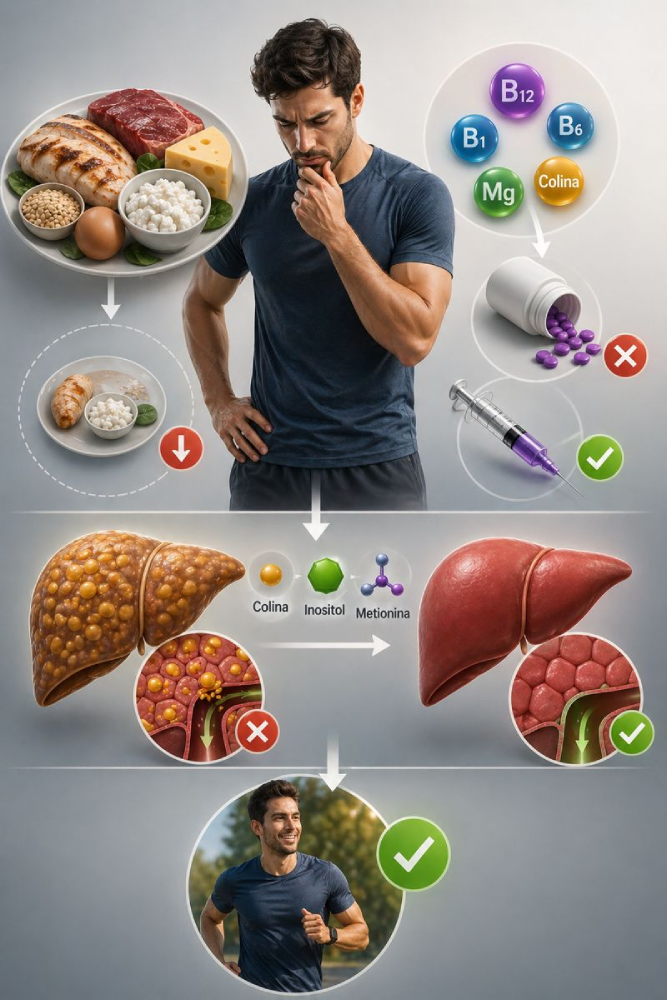
Every calorie restricted is also a nutrient restricted.
The micronutrients most essential for energy metabolism — B12, B-complex vitamins, magnesium, choline — are found predominantly in the foods most commonly reduced during weight loss programs: animal proteins, dairy, and high-calorie whole foods. This creates an inherent tension: the more aggressively you restrict, the more likely you are to develop deficiencies that undermine your ability to continue.
Oral supplementation often doesn't solve this problem effectively. The digestive system's absorption of B12, in particular, is limited and variable — many adults absorb less than 1% of oral B12 supplements. Injectable B12 delivers the nutrient directly into the bloodstream at a guaranteed dose, bypassing absorption variability entirely.
Lipotropic compounds address a separate but equally important mechanism: hepatic fat mobilization. The liver is the primary organ for fat metabolism. When choline, inositol, and methionine are insufficient, fat accumulates in the liver rather than being exported as energy — creating a metabolic bottleneck that slows weight loss independently of caloric intake.
We include B12, B-complex, folate, magnesium, and lipid panel markers in our baseline lab work. If your levels suggest depletion, we'll incorporate nutritional support as part of your program from the start — not as an afterthought when symptoms appear.
Two targeted nutritional therapies. Both designed to make your program work better.
These are not standalone weight loss treatments — they are precision supports that make your primary program more effective and sustainable.
Not sure which one? We'll guide you after reviewing your bloodwork.
Methylcobalamin B12 injections for 100% bioavailable absorption — bypassing stomach acids that destroy oral supplements. Boosts energy for exercise, supports fat metabolism, and is included standard in the Phentermine program (4 weekly shots).
Prescription appetite suppressants — Phentermine (OPH), Ephedra-free — combined with a physician-designed meal plan (1200 cal women / 1800 cal men) and exercise program. 90% of patients lose weight on our supervised programs.

B12 Injections vs. Appetite Suppressants — which do you need?
Many patients benefit from both. Your physician will assess your specific deficiencies and hunger pattern to make the right recommendation.
| Feature | B12 Injections ⭐ | Appetite Suppressants |
|---|---|---|
| Primary target | Energy & metabolism | Hunger & cravings |
| Mechanism | Cellular energy cofactor | Neurological appetite suppression |
| Delivery | Intramuscular injection | Oral / prescription |
| Frequency | Weekly or bi-weekly | Daily |
| Onset of effect | 1-2 weeks | Days to 1 week |
| Standalone use | ✓ Yes | ✓ Yes (with monitoring) |
| Best combined with | Any weight loss program | iControl or caloric restriction phase |
What you eat matters. What your cells can use matters more.
Injectable nutritional support isn't about replacing food — it's about ensuring that during the stress of caloric restriction, your cells have the cofactors they need to metabolize fat efficiently, sustain energy, and maintain neurological function. Patients who maintain adequate micronutrient levels during weight loss programs show better adherence, fewer plateaus, and more consistent mood throughout.
Simple, quick, and immediately effective.
We review your current energy levels, cravings pattern, fatigue, and existing program. Lab results from your initial evaluation tell us what's actually deficient.
Your physician recommends the right nutritional support — B12 alone, B12 + B-complex, appetite suppressants, or a combination — based on your deficiency profile and program.
B12 and Lipotropic injections are administered in-clinic or available as take-home self-injection kits. Appetite suppressants are prescribed same-day.
Most patients receive nutritional injections weekly or bi-weekly alongside their primary program. We reassess at each check-in and adjust as your program progresses.
Medicine that
gets you.
Nutritional support isn't an afterthought at IUVENTUS — it's built into every weight loss protocol from the first evaluation.
Assessed from day one
We check your B12, folate, and lipid markers at baseline — not when symptoms appear. Deficiency prevention is more effective than deficiency treatment.
Injectable for guaranteed results
We use injectable B12 and Lipotropic formulations — not oral supplements — because injectable delivery guarantees the dose actually reaches your cells.
Integrated into your program
Nutritional support is part of your protocol, not an add-on. Your physician factors in your deficiency profile when designing your weight loss plan.
Physician-monitored throughout
Your levels are rechecked regularly. If your program or body changes, your nutritional support changes with it.
Support that makes
the difference.
Everything you
want to know.
Feel better while you lose weight. Not after.
Nutritional support isn't a luxury add-on — it's what makes the difference between struggling through a program and actually thriving in it. Book a consultation and we'll assess exactly what your body needs.